
These fabulous looking spiders are CHACO GOLDEN KNEE TARANTULAS, which in the wild can be found in parts of Argentina and Paraguay (including the northern Argentinian province of Chaco, hence their common name). The individual in this first picture is an adult male named Messi!
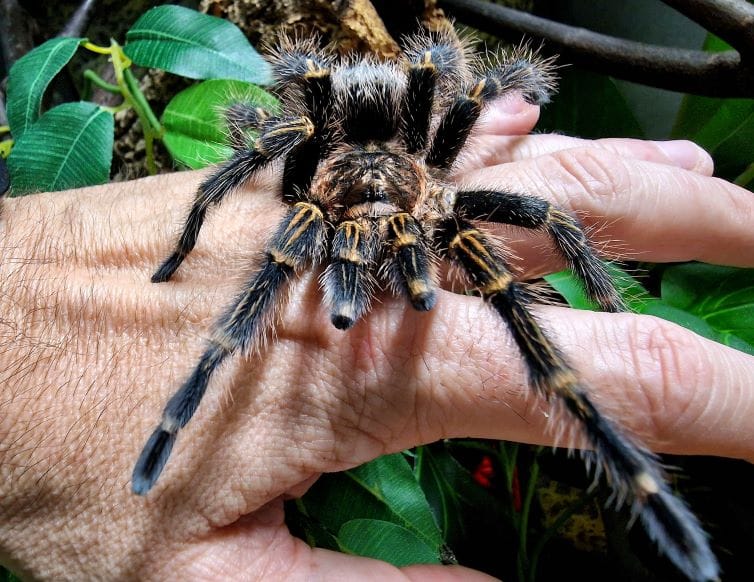


I believe this to be one of the most beautiful tarantula species, with its wonderful golden stripes on its 'knees', hence the other part of its common name. You can see the lovely gold striping clearly in the picture below, which was taken by the very talented Jenny Varley at a macro photography workshop for which I provided all the animal subjects in January 2017!
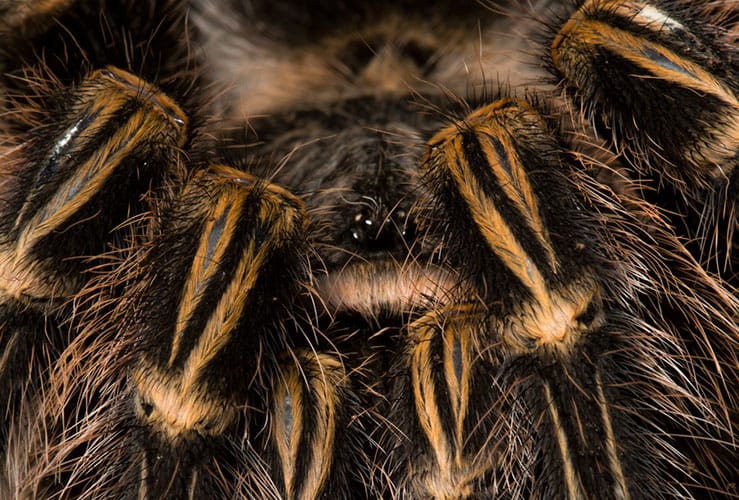
As well as this lovely picture Jenny also took a couple of others that I really liked - here they are:


If you like these pictures please feel free to check out Jenny's website, full of truly amazing images of animals in their natural habitats: http://www.jennymvarley.co.uk/
Like all tarantulas Chaco golden knees have eight eyes positioned in a small cluster at the front of the carapace (head area), some of which can be seen here:

Despite having eight eyes a tarantula's vision is very poor and instead of seeing well they have very sensitive hairs all over their body which are used to detect the tiniest vibrations through the air or on the ground. These hairs provide them with an early warning system when danger (for example a predator) approaches and also the ability to detect prey animals in their environment, so that they can rush towards them ready to attack!

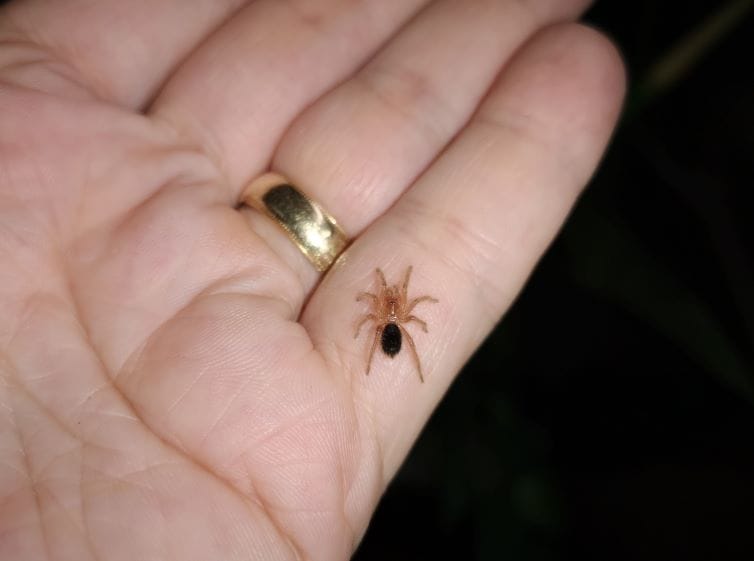
Although individuals of this species can be very large indeed as adults, they start off in life VERY different in size - the picture below is of a Chaco golden knee spiderling at just a couple of weeks old!
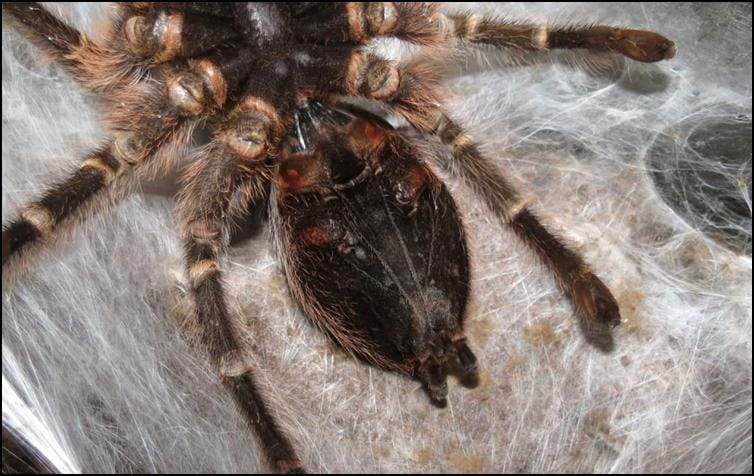
Like all spiders, individuals of this species have to moult periodically. Here is the scene I encountered one time, with my adult female named Fluffy lying on her back on top of a beautiful silken 'blanket' she had created in readiness for the moulting process:
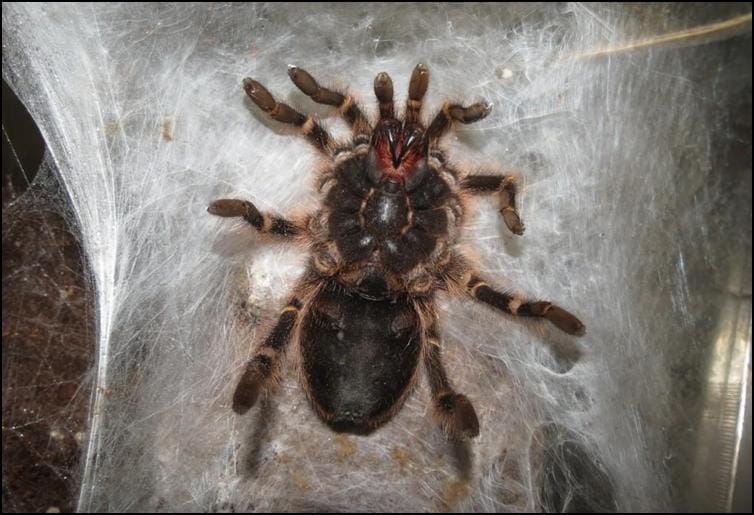
Tarantulas often appear motionless for a couple of hours or more at the beginning of the process but internally there is a lot going on! The pictures below were taken several hours later when the old exoskeleton was separating from the new one. You can see that the thin layer of exoskeletal 'skin' covering the abdomen is visibly loosening as it begins to be removed, hence the ridges which are not usually visible.

Unfortunately I had to leave my home for a school visit straight after these pictures were taken - by the time I returned home many hours later she had finished her moult! The 'real' Fluffy is on the right of the image below, with her moulted exoskeleton on the left.

As always her moulted exoskeleton (exuvia) was perfectly preserved and I was able to set it into a great position, looking just like the real thing in fact, so that I can share it with people I meet in schools etc. and use it as an educational resource like all the others I have here. It truly is a remarkable thing and never ceases to amaze me, no matter how many times I see this process happen!
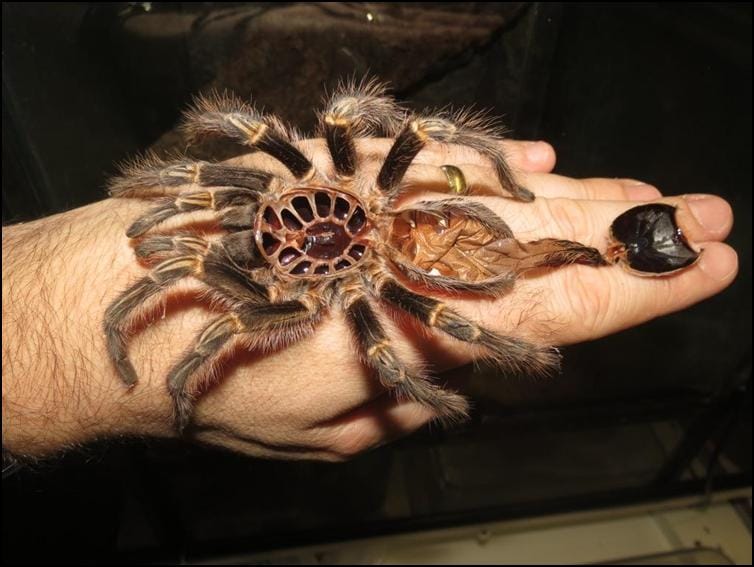
In the two pictures below the carapace (or head area) is in place in the first picture and flipped open in the second, clearly showing the holes through which the new exoskeleton is pulled free during the moulting process!
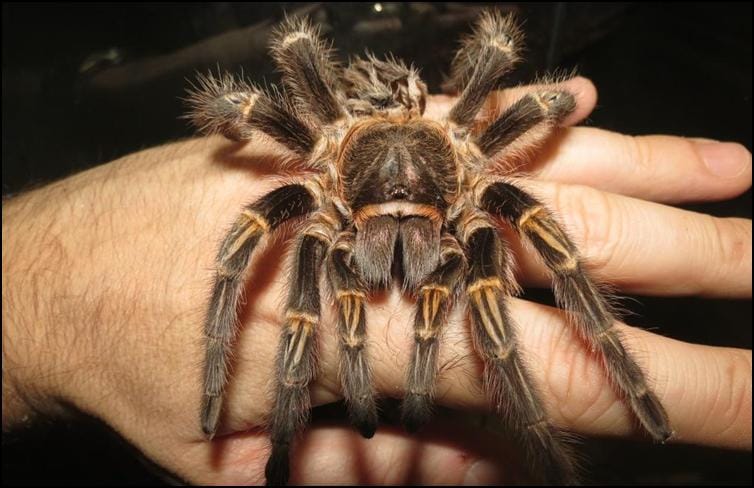

Despite having large fangs and a venomous bite for killing their prey, none of my tarantulas has ever bitten me. As long as a tarantula does not feel threatened or in any kind of danger it will be very reluctant to bite and I carefully handle all of my tarantulas regularly without concern for my safety. Despite their fearsome reputation the bite of most tarantulas is not particularly dangerous to people anyway, the effect of their venom being roughly equivalent to a bee sting. Sadly they are often portrayed as mindless killing machines by the media, which couldn't be further from the truth!


I do not allow other people to handle any of my tarantulas, partly due to their venom (despite their calmness if handled correctly) but mainly due to their extreme fragility. If a tarantula is dropped from even a small height the chances of serious injury or death are very high due to their delicate abdomen, which can easily rupture or even burst when it comes into contact with any surface following a fall. Fluffy, Messi and my other tarantula friends are far too important to me for this risk to be taken!